New Blog Post - Copy
How to Hire a Virtual Assistant for E-commerce
The Shopify Founder’s Guide to Hiring a VA (Without Losing Your Mind or Margin)
You’ve made it. Your Shopify store is generating consistent revenue, your ads are converting, and you finally have a validated product.
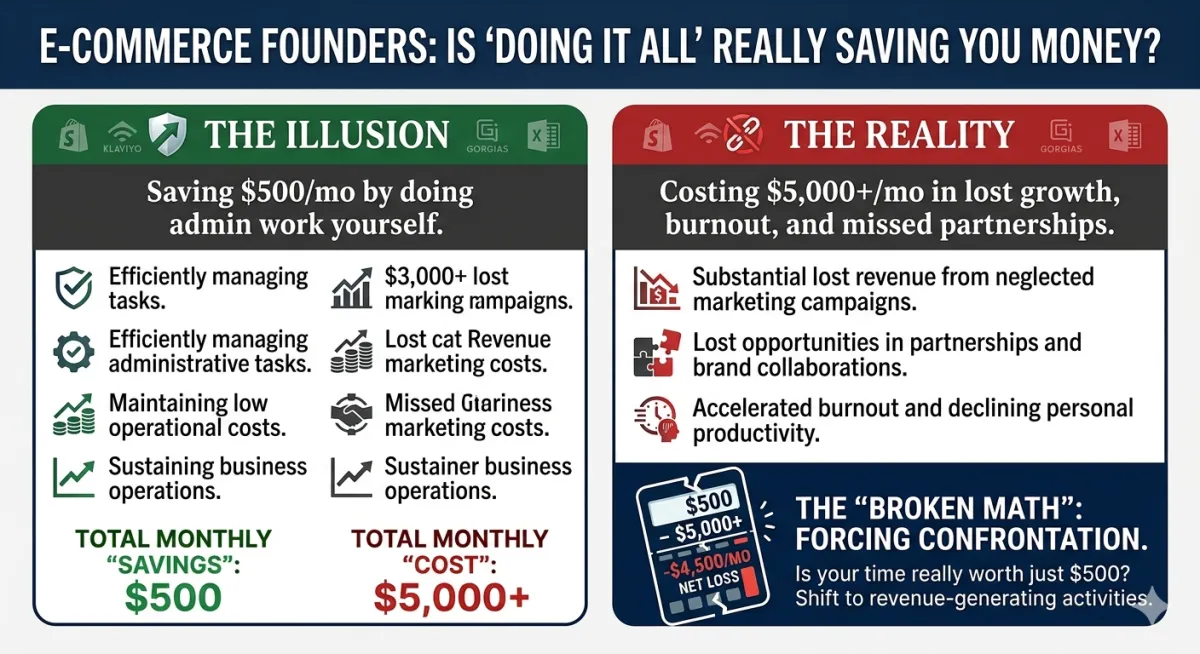
Then reality hits. Instead of focusing on growth, you are spending your Monday mornings managing inventory discrepancies, your Tuesday afternoons copy-pasting tracking numbers, and your evenings answering “Where is my order?” tickets in Gorgias.
You need help. But for an e-commerce founder, hiring your first Virtual Assistant (VA) feels like a massive risk. You worry about data security, the hours it will take to train them, and whether they’ll make a mistake that tanks your customer review score.
The truth is, hiring a great e-commerce VA isn't about luck. It’s about running a strict, predictable process. Here is the operational framework to source, vet, and onboard a high-performing e-commerce VA without the administrative headache.
1. Map Your Operational Bottlenecks First
Never hire a VA to "help run the store." That is too vague, and vague hiring criteria often lead to misaligned expectations. Before you write a job description, look at your weekly routine and isolate the specific, repetitive tasks that don't require your unique strategic mind.
For a scaling Shopify brand, these usually fall into three distinct buckets:
Front-End Customer Experience: Managing live chat, processing returns/exchanges, handling email tickets, and responding to social media comments.
Back-Office Inventory & Logistics: Updating supplier spreadsheets, tracking production milestones, flagging low-stock alerts, and updating product variants.
Marketing Operations Support: Setting up basic email segmentation rules, scheduling social posts, uploading creative assets, and updating landing page copy.
Pick one bucket to hand off first. Do not hire one person and expect them to launch TikTok ads, write copy, and fix liquid code all on day one. Start with clear, structural administrative boundaries.
2. Source from the Right Talent Ecosystem
Where you look determines who you find. If you throw a generic job post onto a massive, unvetted freelancer marketplace, you will get flooded with hundreds of generic resumes within hours—forcing you to spend your weekend filtering through noise.
The standard marketplace route requires a heavy operational tax from you:
The Keyword Filter: You have to manually filter out candidates who don’t explicitly list your exact tech stack (e.g., Shopify, Klaviyo, Asana).
The Loom Test: You have to build custom video screening challenges just to verify if they can follow basic directions.
The Culture Check: You have to handle all background and reference checking yourself.
To scale fast, you need a talent pipeline that is already oriented around the modern e-commerce stack.
3. Vet for Technical Competency, Not Just "Years of Experience"
A resume that says "5 years of e-commerce experience" means nothing if those five years were spent on an outdated platform. In e-commerce, execution speed is everything. You need to test for platform familiarity.
During the vetting phase, look for concrete proof of these specific skill sets:
Core Skill Area
What They Must Know
Why It Matters to Your Store
Shopify Dashboard
Managing orders, issuing partial refunds, updating tags, editing product details.
Prevents fulfillment delays and order processing errors.
Customer Support Tech
Gorgias, Zendesk, or Help Scout macros, tracking loops, tag assignments.
Keeps your customer response times under 2 hours.
Operations Hubs
Notion, Asana, ClickUp, Slack.
Ensures they can communicate asynchronously without missing tasks.
AI Tooling Integration
Using Claude or ChatGPT to draft polite customer responses or summarize transcripts.
Boosts their operational output by 3x to 4x.
4. Mitigate Your Security Risks On Day 1
The biggest fear founders have when bringing an assistant into their store is security exposure. You do not have to hand over your primary password or expose your banking details to delegate successfully.
Protect your business by enforcing these three strict rules:
Never Share Master Passwords: Use a secure credential manager like Bitwarden or 1Password to share access to tools without ever revealing the actual text password.
Enforce Staff Account Scoping: Create a distinct staff account within Shopify, Klaviyo, and your customer service platform. Explicitly restrict their permissions. They should only see what they need to execute their job—no direct access to export customer lists or modify financial settings.
Use a Dedicated Workspace: Ensure all team communication happens inside dedicated company channels (like Slack or structured Notion spaces) rather than personal messaging apps.
The Alternative: Skip the Hiring and Training Grind
Hiring, training, and managing a remote VA is a full-time job. For an e-commerce founder trying to push past a revenue ceiling, spending 30 hours building training academies and auditing daily KPI reports is a massive diversion of focus.
That is why we built Xecutely.
We don't match you with random freelancers and leave you to figure out the rest. We provide U.S. e-commerce businesses with pre-trained, fully managed virtual assistants who already know Shopify, Klaviyo, Gorgias, and Notion before their very first day. Our internal operational team handles the training, quality assurance, and weekly KPI reporting for you—giving you total leverage without the management headache.
Ready to Step Out of the Operational Weeds?
Let’s look at your current workload and see what you can safely take off your plate this week. Get a clear look at how an AI-augmented, fully managed team can stabilize your back-office operations so you can focus entirely on scaling.
